One of the biggest misconceptions in fitness is that more is always better.
More workouts.
More hours.
More sweat.
More suffering.
The reality is that meaningful improvements in health don’t require you to spend every day in the gym.
In fact, research consistently shows that just one or two sessions of High-Intensity Interval Training (HIIT) per week can significantly improve a range of important health markers.
For many people, that’s welcome news.
Because the biggest barrier to exercise isn’t usually motivation.
It’s time.
Between work, family commitments, running a household and trying to maintain some balance in life, finding time to exercise can feel overwhelming. The good news is that your body doesn’t necessarily need more exercise. It simply needs the right stimulus, applied consistently.
What is HIIT?
HIIT stands for High-Intensity Interval Training.
It involves alternating short periods of hard effort with periods of recovery. The sessions are typically shorter than traditional workouts but are designed to challenge both the cardiovascular and muscular systems.
The goal isn’t to leave you exhausted for days afterward.
The goal is to create enough stimulus for your body to adapt and become healthier, fitter and more resilient.
The Benefits Go Well Beyond Fitness
When most people think about exercise, they think about weight loss or improving appearance.
But some of the most important benefits happen internally.
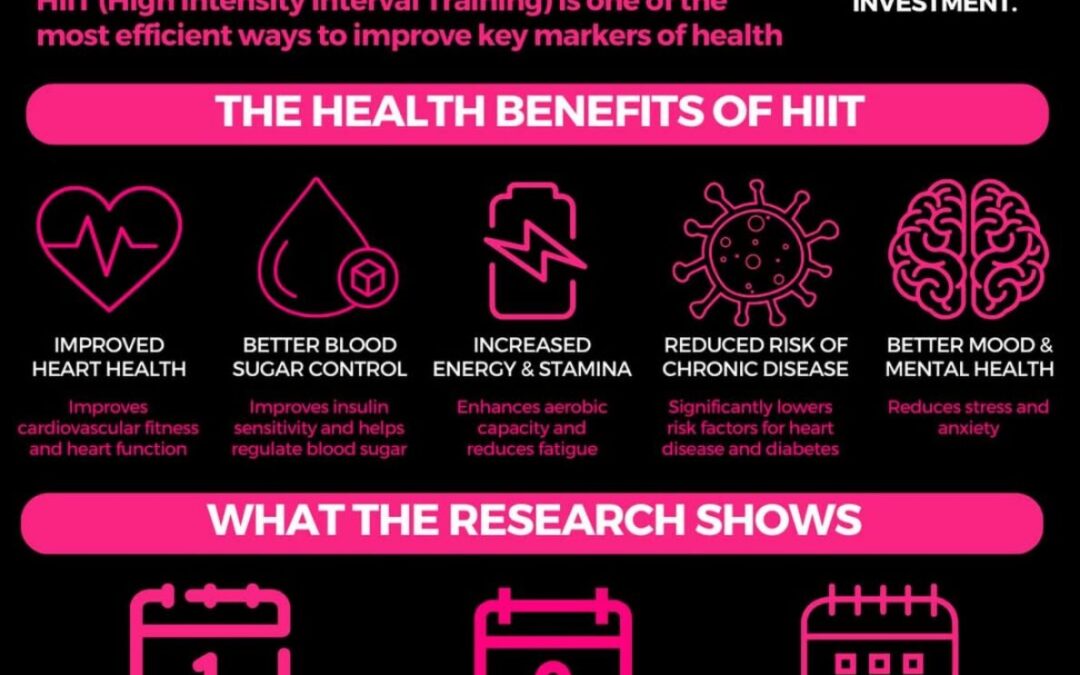
Research has shown that HIIT can improve:
• Cardiovascular fitness (VO₂ max)
• Blood sugar regulation
• Insulin sensitivity
• Heart health
• Metabolic health
• Overall cardiometabolic risk factors
These improvements are important because they are closely linked to long-term health outcomes, quality of life and the risk of developing chronic diseases.
What Does the Research Say?
The evidence supporting HIIT is substantial.
A review by Gibala and colleagues (2012) found that low-volume HIIT can produce significant improvements in aerobic fitness and metabolic health in both healthy individuals and clinical populations. What’s particularly interesting is that these benefits were achieved with surprisingly small amounts of weekly exercise.
A large meta-analysis by Milanović and colleagues (2015) found that HIIT is at least as effective as traditional moderate-intensity continuous training for improving VO₂ max, one of the strongest indicators of cardiovascular fitness. In many cases, it achieved these results in less total training time.
Similarly, Weston and colleagues (2014) reported significant improvements in cardiovascular fitness across a wide range of populations, further reinforcing HIIT’s effectiveness as a health intervention.
Research has also demonstrated meaningful improvements in insulin sensitivity and glucose regulation. Jelleyman and colleagues (2015) found that HIIT can positively influence blood sugar control, even over relatively short training interventions.
This is one of the reasons HIIT has become so widely used not only in fitness settings, but also in clinical exercise and health programs around the world.
Why Consistency Matters More Than Perfection
Perhaps the most important takeaway from this research is that health improvements don’t require perfection.
You don’t need to exercise seven days a week.
You don’t need to spend hours doing cardio.
You don’t need to structure your entire life around fitness.
What matters most is consistency.
A realistic program that you can maintain for months and years will almost always outperform an aggressive program that leaves you burnt out after a few weeks.
That’s where many people get stuck.
They believe health requires an all-or-nothing approach.
But health is rarely built through extreme efforts.
It’s built through small, repeatable actions performed consistently over time.
The Body MBrace Approach
At Body MBrace, we believe fitness should fit into your life, not take over it.
That’s why we focus on training that is sustainable, supportive and evidence-based.
Our goal isn’t to see how much exercise we can squeeze into your week.
Our goal is to provide the right amount of training to help you become stronger, healthier and more confident while still having the energy and time for everything else that matters.
Because fitness shouldn’t feel like another burden on your to-do list.
It should be something that improves your quality of life.
The research is clear.
You don’t need to train every day to improve your health.
You simply need the right stimulus, delivered consistently.
And for many people, one or two quality sessions each week can be enough to start creating meaningful change.