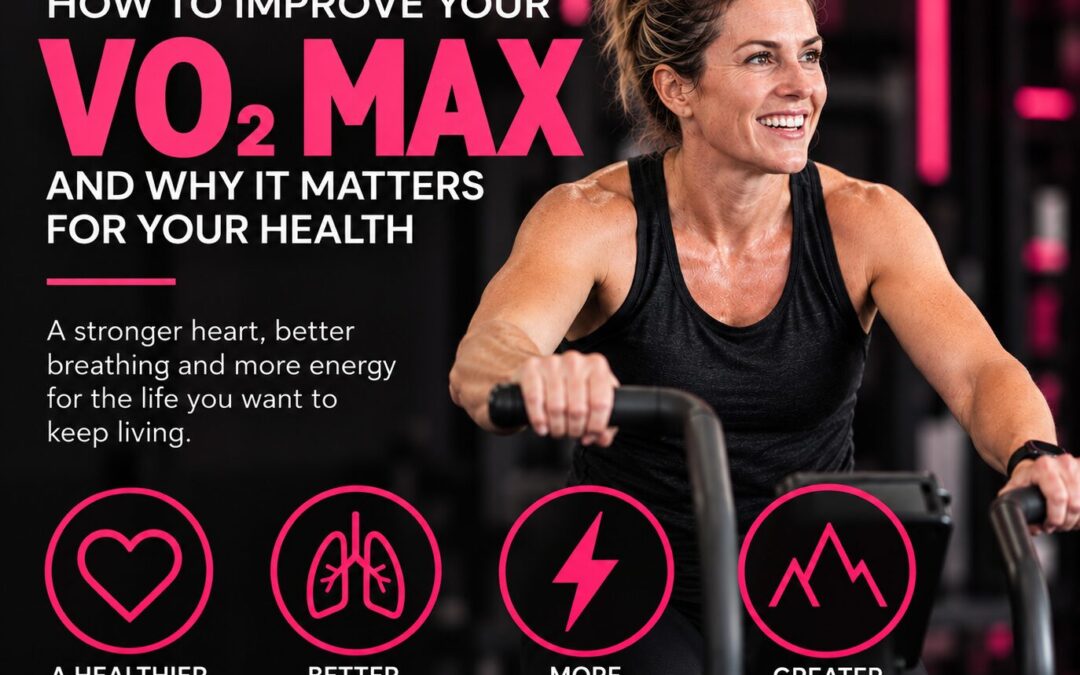
There’s a reason we keep banging on about cardio.
We talk a lot about getting stronger as we age, and rightly so. Maintaining muscle and strength is incredibly important.
But there’s another part of your fitness that deserves just as much attention: your cardiorespiratory fitness.
And one of the best measures we have of it is something called VO₂ max.
What is VO₂ max?
VO₂ max is essentially a measure of how well your body can take in, transport and use oxygen when you’re exercising at a high intensity.
The higher your VO₂ max, the greater your body’s capacity to deliver oxygen to your working muscles and use it to produce energy.
You don’t need to be an athlete to care about this.
Your VO₂ max is a reflection of how effectively several important systems in your body are working together, including your heart, lungs, blood vessels and muscles.
That makes it a very useful measure of your overall cardiorespiratory fitness.
Why is VO₂ max so important for your health?
This is where things get particularly interesting.
Cardiorespiratory fitness is strongly associated with long-term health and longevity.
Large studies have consistently found that people with higher levels of cardiorespiratory fitness have a lower risk of cardiovascular disease and premature death.
In fact, cardiorespiratory fitness is such a powerful predictor of health outcomes that the American Heart Association has argued that it should be considered a clinical vital sign.
And importantly, you don’t need an elite VO₂ max to benefit.
Improving your fitness from wherever you are now matters.
Think about what better cardiovascular fitness means in everyday life.
Walking up a hill is easier. Climbing stairs doesn’t leave you as breathless. You can keep up with the kids or grandkids. You recover more quickly when you exert yourself. Everyday activities require a smaller percentage of your maximum capacity.
In other words, you’re building a bigger cardiovascular engine.
Can you improve your VO₂ max?
Absolutely.
Unlike your age or genetics, cardiorespiratory fitness is something you can train.
And this is one of the reasons we use high-intensity interval training (HIIT) at Body MBrace. HIIT is one of the most time-efficient ways to challenge your cardiovascular system and improve your fitness.
During HIIT, you alternate periods of higher-intensity exercise with periods of recovery.
Your heart rate rises. Your body has to deliver more oxygen to your working muscles. You recover. Then you ask it to do it again.
Repeated consistently over time, this provides a stimulus for your cardiovascular system to adapt.
Your heart can become more effective at pumping blood, your muscles can become better at extracting and using oxygen, and your overall aerobic capacity can improve.
That’s why improving your VO₂ max isn’t about simply exercising until you’re exhausted.
It’s about giving your body an appropriate cardiovascular challenge, recovering, and repeating that process consistently.
HIIT isn’t just about burning calories
This is something we really want people to understand.
The bike, rower and cross trainer aren’t just there to make you sweat.
And cardio shouldn’t simply be viewed as something you do to burn calories.
When you’re working through those intervals and watching your heart rate climb, you’re training one of the most important components of your long-term physical capacity.
You’re training your cardiovascular system.
That’s one of the reasons we monitor heart rate during our 30-minute HIIT sessions at Body MBrace. It allows us to see how hard your cardiovascular system is actually working rather than relying purely on how an exercise looks or feels.
For someone new to exercise, the intensity required to challenge their cardiovascular system may be quite different from someone who has been training for years.
The goal isn’t for everyone to work at exactly the same speed or resistance.
The goal is to create the right challenge for you.
Strength training or cardio? You need both.
There has been a huge amount of attention placed on strength training in recent years, particularly as we get older.
That’s a good thing.
We want to maintain muscle, strength, bone health and physical function as we age.
But it shouldn’t come at the expense of cardiovascular fitness.
Strength training and cardio create different adaptations, and both contribute to keeping you healthy and physically capable.
So rather than asking whether you should be doing strength training or cardio, a much better question is whether your exercise program is giving your body enough of both.
At Body MBrace, that’s exactly why our program includes both cardio and resistance-based training.
Train for the life you want to keep living
Ultimately, improving your VO₂ max isn’t about chasing a number on a fitness test.
It’s about capacity.
You want enough cardiovascular fitness that the things you enjoy doing don’t gradually become the things you used to be able to do.
You want to travel. Walk up hills. Carry shopping. Play with your kids or grandkids. Keep exercising. Stay independent. And have enough physical capacity in reserve when life asks more of you.
That’s why we keep banging on about cardio.
Every time you push your heart rate up, recover and go again, you’re not simply completing another interval.
You’re giving your cardiovascular system a reason to adapt.
And you’re training your heart, lungs and body for the life you want to keep living.